 Go to the homepage


Old tower and churchyard
Although the vicarage garden soon caught Vincent’s attention, it was the description of the Old Tower and the adjoining churchyard that aroused his curiosity about Nuenen even before his arrival. ‘What you tell me about their new surroundings interests me greatly. I would certainly very much like to try my hand at painting such an old church and churchyard with sand graves and old wooden crosses,’ he wrote to Theo in August 1882. The idea was still on his mind in October: ‘The churchyard with the wooden crosses is really playing on my mind, so much so that I might even start making some preliminary studies for it – I’d quite like to paint something like that in the snow – a peasant’s funeral or something like that’.
The cemetery with the crosses near the tower in the snow is indeed one of the first motifs he sketched in Nuenen. The subject recurs throughout his stay in Nuenen; Vincent captured the scene more than thirty times. Sometimes the tower takes centre stage; at other times it appears in the background. He could see the tower from the vicarage garden and found the structure standing in the middle of the fields, outside the built-up area of Nuenen. A small church had probably already stood on that site around the year 1225. The church was extended or possibly completely rebuilt at the end of the fifteenth century, and following a disaster several decades later, the tower was fitted with a short spire.
In the eighteenth century, the building fell into disrepair, though the tower was restored in 1803, albeit to a lower height. The church section was cleared in 1823, with the materials being reused for the new St Clement’s Church in Nuenen. The tower was preserved and stood alone in the fields. Although the tower had been earmarked for demolition since 1873, it was not until 1884 that the bells were moved to St Clement’s Church and the demolition was discussed. In May 1885, the spire was demolished; the sale took place in stages, and it was not until the course of 1886 that the tower was razed to the ground. Vincent followed the proceedings closely: ‘The old tower in the fields is being demolished.– There was now a sale of timber, slates and scrap iron, including the cross.’ The sale of demolition materials provided him with an interesting subject.
In the painting *The Old Church Tower at Nuenen*, which he himself called *Cimetière de paysans*, he sees the half-demolished tower as a symbol of the transience of faith. In contrast, ‘for centuries the peasants have been laid to rest in the very fields which they tilled during their lives’, and thus, in his eyes, their lives remain unchanging. In the cemetery by the tower, Catholics are buried in the northern section and Protestants in the southern section. The small mortuary next to the tower can be recognised in many of Vincent’s works.
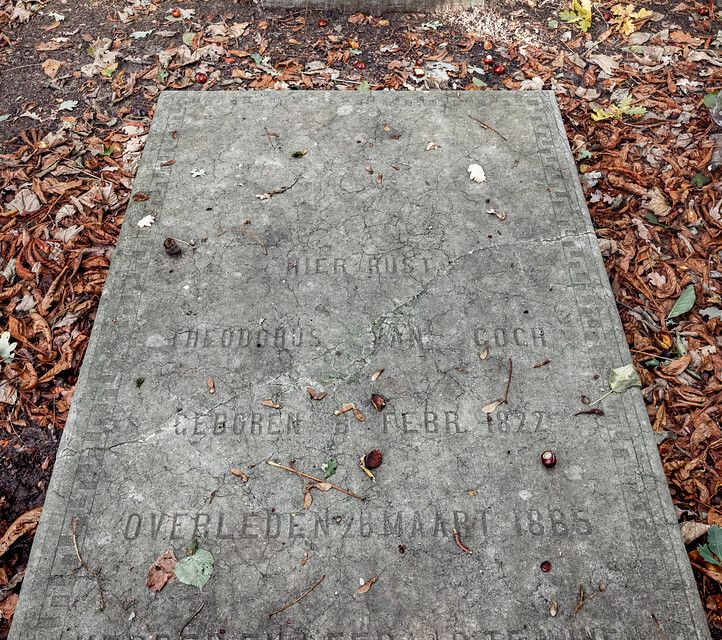
The site took on greater significance when his father died on 26 March 1885 and was buried four days later – on Vincent’s 32nd birthday – in the cemetery, which was still in use at the time. The grave is still there today. The foundations of the old tower have been preserved and are now marked by gabions.