After unsuccessful attempts as an art dealer, schoolteacher, bookseller and minister, the 28-year-old Vincent van Gogh returned to his parents’ home in the vicarage at Etten in April 1881. He was penniless but determined: he wanted to become an artist. Etten became his training ground, the place where he began to work in earnest on his development as a painter.
Here, Vincent sketches every day, searches for models and subjects, and tries to find his own style. He falls in love, makes life-changing decisions and comes into conflict with those around him. Etten marks a turning point in his life — the beginning of his artistic journey.
1853 | Born in Zundert
Vincent van Gogh was born on 30 March 1853 in Zundert. He learnt to read and write at the village school opposite the vicarage. His mother taught him to draw and encouraged his love of nature. At a young age, he attended a boarding school in Zevenbergen and later the HBS in Tilburg. It was there that he received his first formal art lessons. In 1868, he left school early and returned home.
1872 | First steps in the art world
At the age of 16, Vincent began working at the art dealers Goupil & Cie, through his uncle ‘Cent’. He worked in The Hague, London and Paris, where he became acquainted with the works of Millet and Breton. However, his interest shifted increasingly from commerce to religion. In 1876, he was dismissed.
1875 | Van Gogh moves to Etten
Vincent’s parents moved to Etten, where his father became a minister. Vincent visited them at Easter and Christmas. After his dismissal, he stayed in Etten for two weeks in April 1876, during which time he sketched, amongst other things, the vicarage and the church.
“
— Vincent to Theo, 1875
”
“I hope to be in Etten in 14 days’ time; you can well imagine how much I long to be there.”
1876–1877 | A search for meaning
Vincent set off once more for England as an assistant preacher, but returned to Etten at Christmas. On his father’s advice, he took a job in a bookshop in Dordrecht. He attempted to study theology in Amsterdam, but dropped out of the course early.
1878 | In the Borinage mining region
In Belgium, Vincent worked as a lay preacher amongst the miners. He lived in poverty and sought to spread the faith through his actions. Although his dedication was appreciated, his mission failed. His contract was not renewed.
“The cheapest option would surely be for me to spend this summer in Etten; there’s plenty of material there.”
— Vincent to Theo, 1881
1881 | Etten: the beginning of his artistic career
Vincent returned to the vicarage in Etten in April. He was given a studio in an outbuilding and worked daily on his drawing skills. He studied prints by Millet, sketching landscapes, farmers and simple village scenes.
“I hope to produce as many studies as I possibly can, for they are the seeds from which drawings will later spring.”
— Vincent to Theo, 1881
Summer 1881 | A love of the landscape
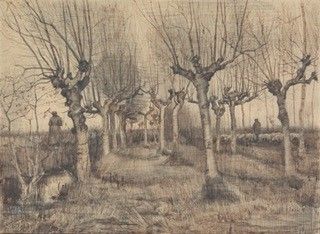
As soon as the weather permits, Vincent heads out. He sketches huts, pollarded willows, the heathland near Seppe and the Passievaart. Together with his friend Van Rappard, he takes long walks through the countryside around Etten.
August 1881 | In love with Kee Vos
During a family visit, Vincent falls head over heels in love with his cousin Kee Vos. He proposes to her, but she resolutely rejects him. The rejection leads to tensions within the family.
“Let me see her… But I think they blew out the lamp.”
— Vincent to Theo
September 1881 | Inspiration in The Hague
Vincent visits The Hague and meets the artist Anton Mauve. Mauve encourages him to paint. On the way, Vincent makes sketches at Kinderdijk. Back in Etten, he immerses himself in drawing farmers and working people.
Autumn 1881 | Farmers as a source of inspiration
Encouraged by Mauve, Vincent began to draw figures more intensively. He sought out farmers and labourers as models – preferably in their working environments. One of his regular models was Piet Kaufmann, a young gardener.
“Diggers, sowers, ploughmen… I must now draw them ceaselessly.”
— Vincent to Theo
The Sower
Vincent van Gogh, December 1882 (private collection)
The Sower
Vincent van Gogh, June 1888 (Kröller-Müller Museum collection)
The Sower
Vincent van Gogh, August 1888 (collection of the Van Gogh Museum, Amsterdam)
The Sower
Vincent van Gogh, November 1888 (collection of the Van Gogh Museum, Amsterdam)
The Sower
Vincent van Gogh, January 1890 (Kröller-Müller Museum collection)
“
Vincent to Theo, Etten, May 1881
”
“If it isn’t raining, I go out every day, mostly onto the heath. That’s how I built a hut on the Heike, and also that barn with a moss-covered roof on the Roozendaal road, which they call the ‘Protestant barn’ here.”
October 1881 | Pollarded willows as characters
Vincent sees trees almost as if they were people. He draws old pollarded willows as though they were living creatures. His attention to detail grows: he observes, compares and works with ever-increasing intensity.
“If you draw a pollarded willow as though it were a living being… the surroundings will follow naturally.”
— Vincent to Theo
December 1881 | His first paintings
Mauve invites Vincent into his studio and gives him his first painting box. Vincent paints three still lifes in oil. With no money, he returns to Etten. There, he ends up in a row with his father.
Late 1881 | Departure from Etten
A row with his father reaches a climax when Vincent refuses to attend the Christmas sermon. Theodorus throws him out of the house. Vincent leaves for The Hague for good to further his development as an artist.
1888 | Memories of Etten
Seven years after his departure, Vincent painted the canvas ‘Souvenir du jardin à Etten’ in Arles. The work is a nostalgic look back at the vicarage garden and his time in Etten.
“For me, it captures the poetic character and style of the garden as I experience it.”
— Vincent to Willemien
 Go to the homepage